



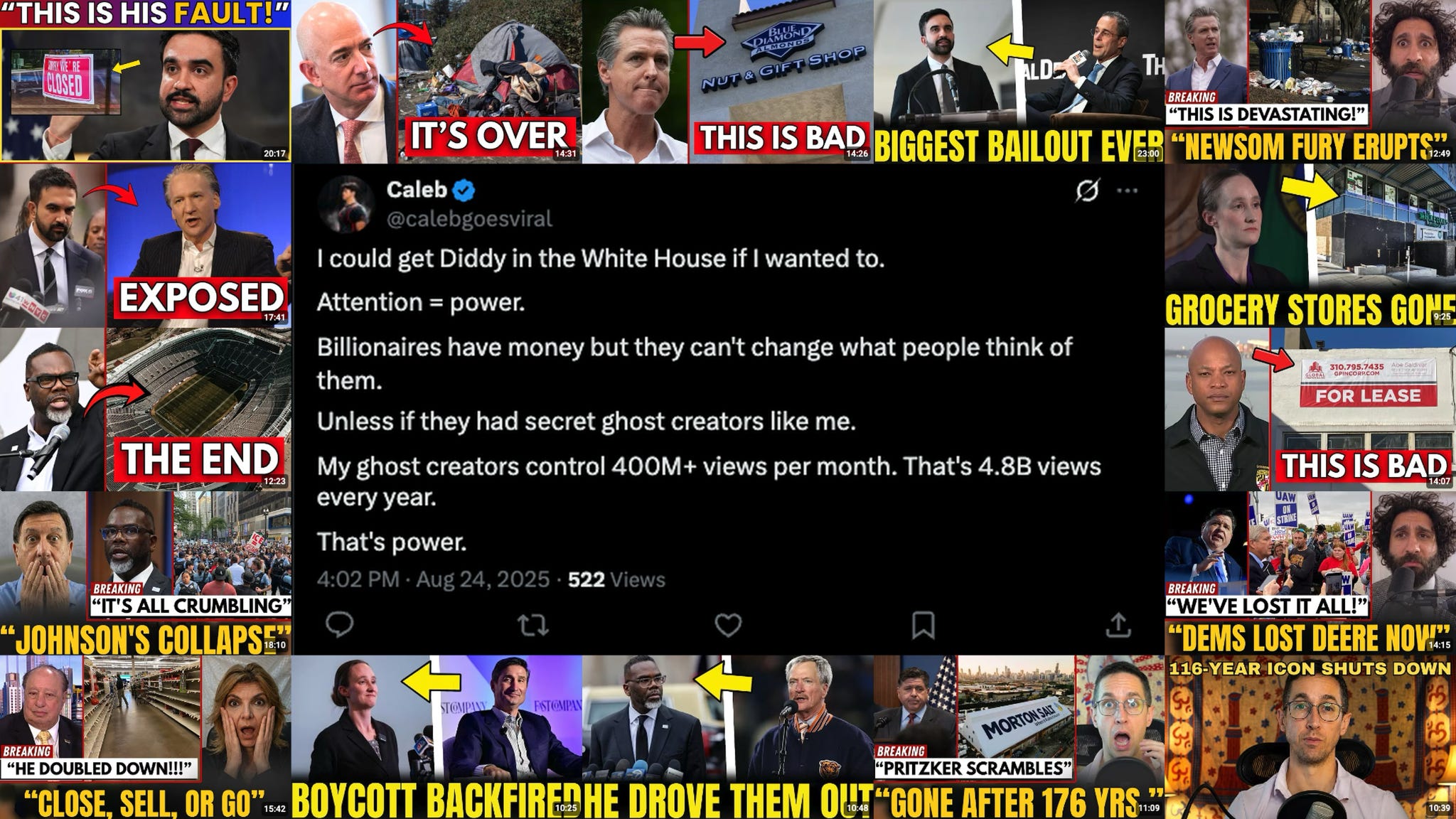
Generative AI already powers fake political influencers, but AI videos are detectable, and channels can get banned if they’re caught. That’s probably why some YouTube automation hustlers are paying actors to read scripts instead of generating AI videos or deepfakes. Riddance identified a network of over a dozen of these hybrid AI personas, or “ghost creators”, which are fake podcasters and journalists portrayed by actors or spokespeople, each with a suite of social media accounts and websites designed to make them look legitimate. They are mostly targeting Democratic mayors, governors, and members of congress. These actors read AI scripts, use AI-generated headshots and thumbnails, and maintain a persistent fake identity.
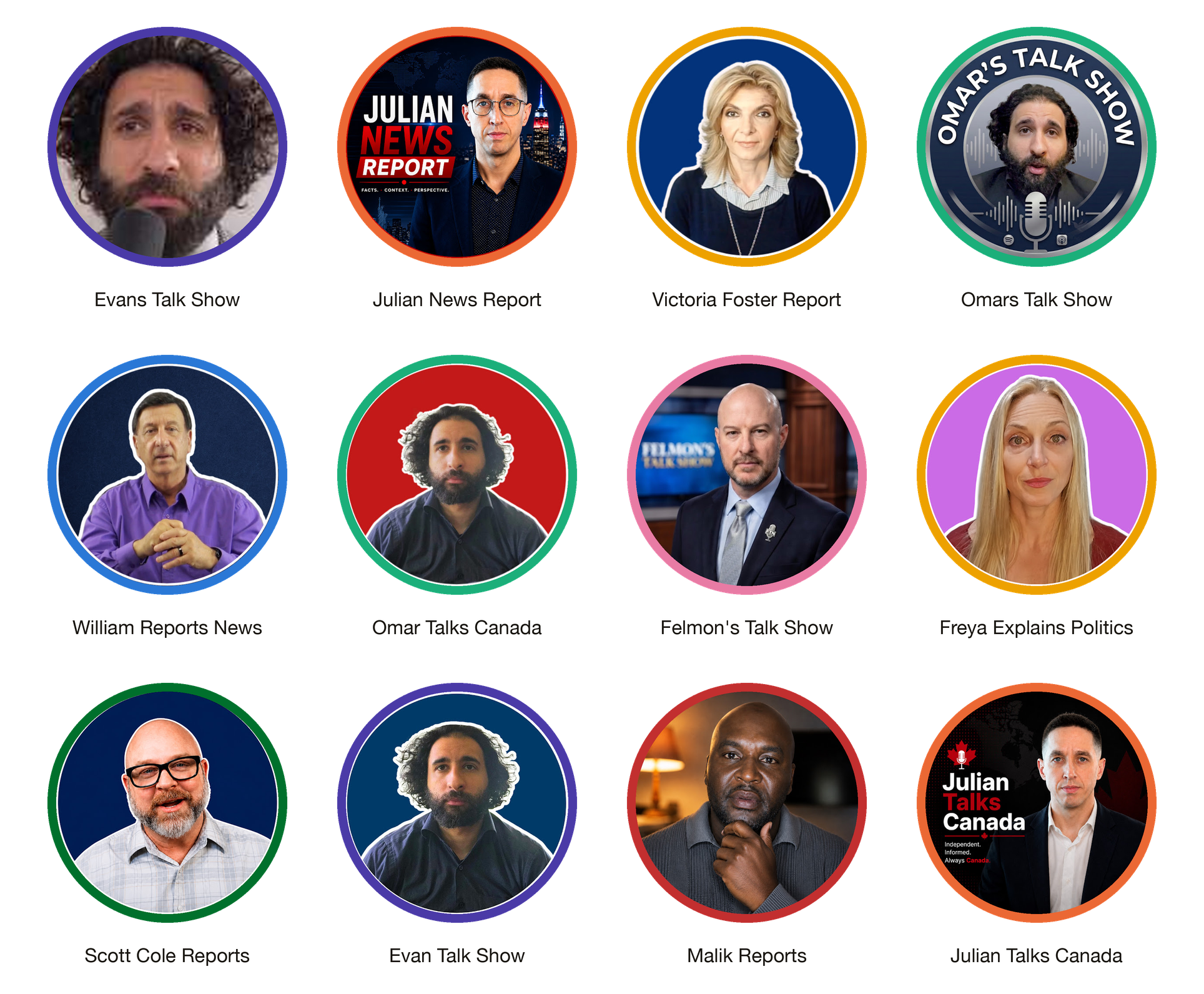
We started tracking these accounts in early June, fascinated by their production methods, which are as sloppy as they are sophisticated. In August, we conducted an investigation (in parallel with reporting by Semafor’s Maxwell Tani) that led us down an unusual path to the production company behind the content: a small company called Virelox, which operates channels pseudonymously.
The network had amassed over 45 million views on YouTube with over 90,000 comments by mid-August, and many of the channels are still live as we write and publish. They appear to have dedicated clipping infrastructure on TikTok, where dozens of accounts circulate moments from long-form videos, integrating the content into an even larger AI-enabled ecosystem of anti-Democrat political commentary.
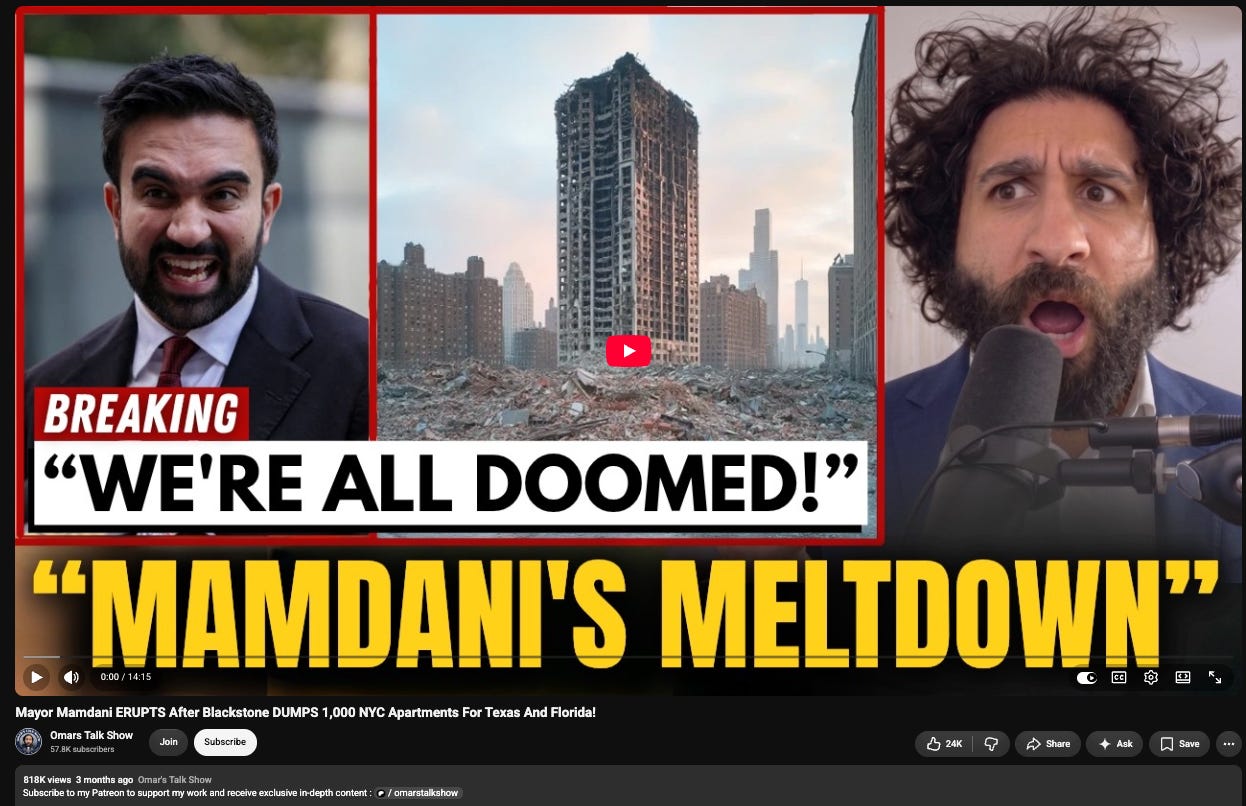
Most of their videos blame Democratic politicians for real-estate crises, corruption, or business exodus from blue states and cities. At least two personas regularly target Canadian Prime Minister Mark Carney, calling out economic decline in Canada caused by left-leaning policies. While one persona briefly targeted President Trump, the vast majority focus on Democrats such as Mayor Zohran Mamdani, Governor Gavin Newsom, and Congresswoman Alexandria Ocasio-Cortez.
In aggregate, these channels represent a sophisticated AI-enabled political influencer operation. They also underscore how a relatively unknown actor can influence political content algorithms, which is especially alarming in the lead-up to the 2026 midterms.
Shared narratives and production techniques pointed to coordination
Riddance connected the accounts in this campaign to one another by analyzing their infrastructure, video production methods, and overlapping content signals in the videos themselves. While the workflows that enable this operation are complex, their attempts to maintain consistent, fake identities across many social media platforms and accounts were imperfect. The sloppiness is evidence of a centralized, AI-assisted operation getting pushed beyond its limits.
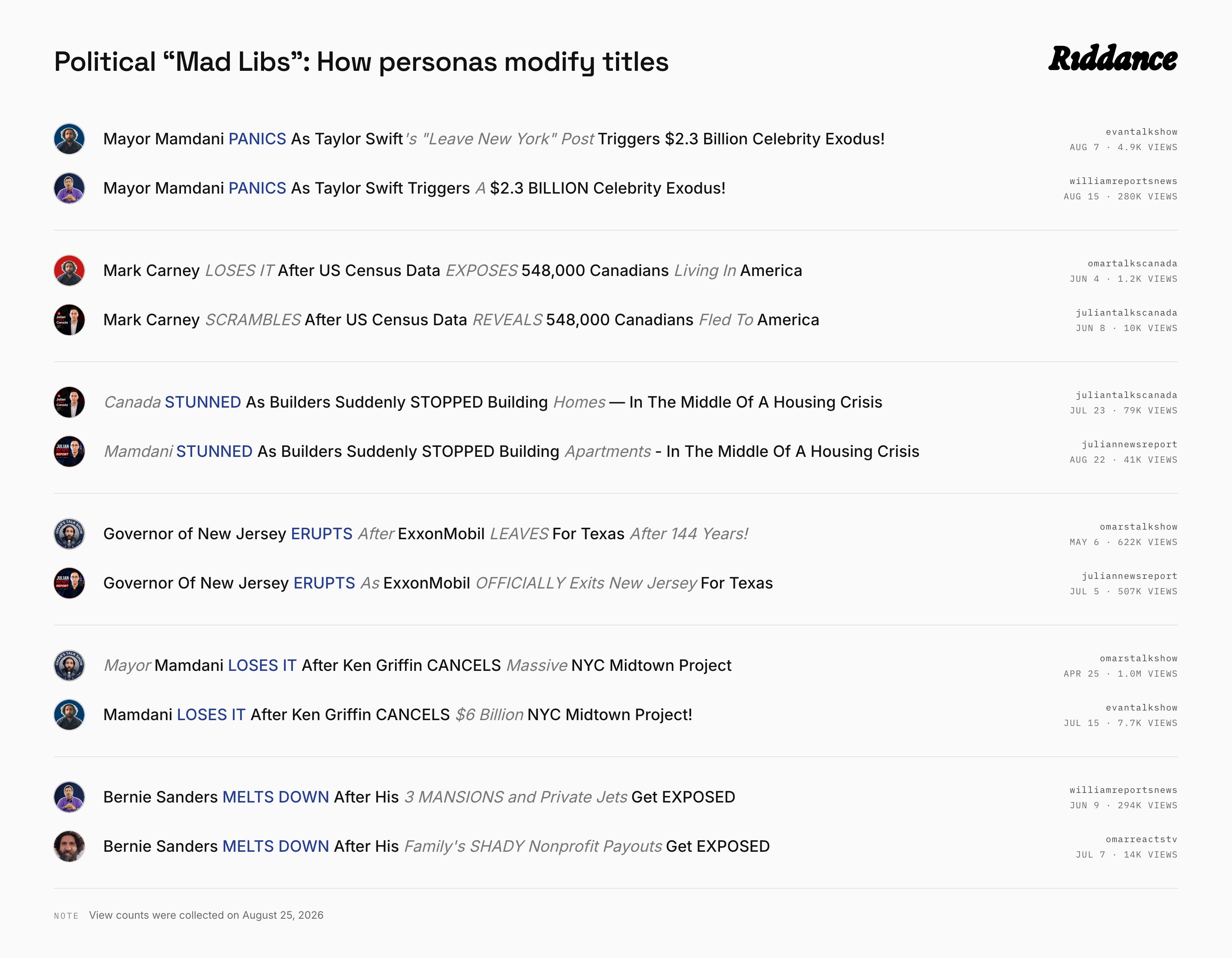
It’s common for AI accounts to recycle titles and scripts to reduce creative burden and follow algorithmic trends. However, this network never shares full scripts or video titles between their accounts. Instead, they share structural similarities and snippets in their title formats, scripts, and storytelling methods.
Their Mad-lib-esque titles often start by naming a Democratic politician, then use an all-caps verb to highlight economic woes involving specific businesses, allege corruption, or discuss a recent scandal. While the majority of claims made in this network are based in reality, some of the titles are highly exaggerated or completely fabricated.
The actors playing the personas deliver direct-to-camera analysis of current events—some entirely fabricated or greatly exaggerated—that overwhelmingly target Democratic mayors, governors, and members of congress.
In order to understand the messaging priorities of this network, Riddance saved every video transcript from every persona. We analyzed 622 transcripts in total. We tallied the mentions of specific individuals, categorized every claim associated with that individual, and then assessed the context in which each claim occurs, enabling us to distinguish passing mentions from sustained commentary.
Tax burden, budget issues and business flight from Democratic states and cities are the most common themes in the network, and New York Mayor Zohran Mamdani is overwhelmingly the most targeted politician with at least 168 videos criticizing him in their titles directly.
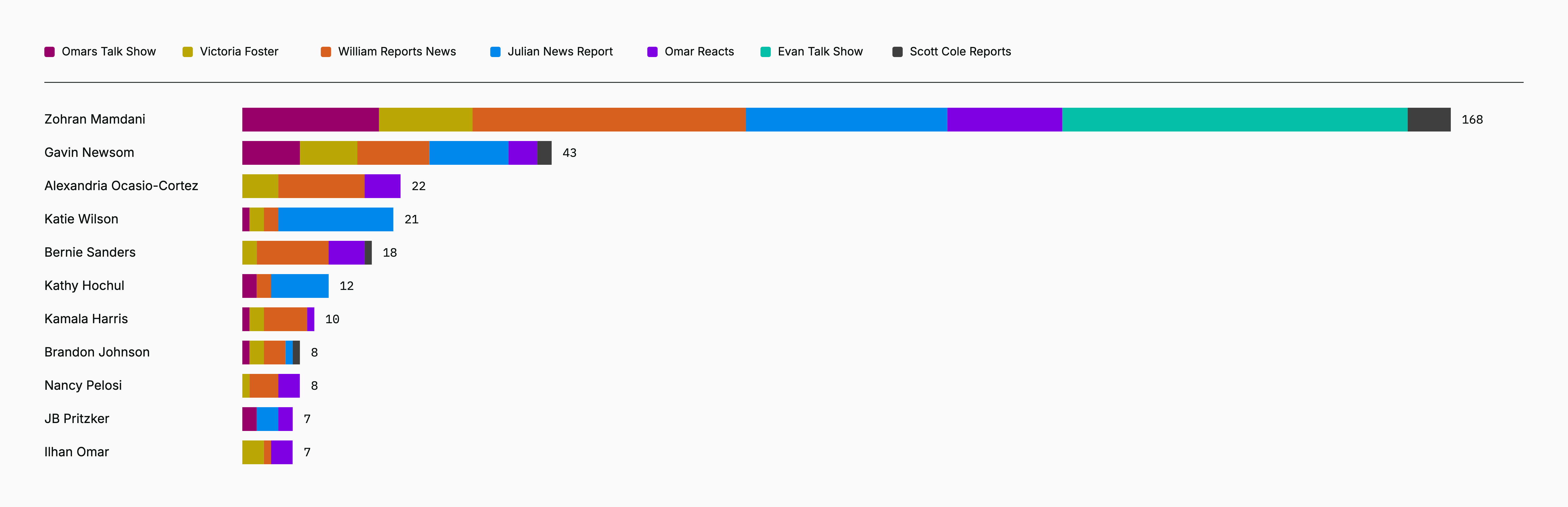
We observed that structural or governance critiques were common for governors and mayors, while personal attacks were more common for members of congress, but nearly every video attacks a single politician with a grab-bag of criticisms.
To better understand the network’s focus, we plotted how channels targeted politicians per topic. This shows which politicians were targeted with what topics most frequently. For the interactive version of the chart below, see our report at riddance.ai.
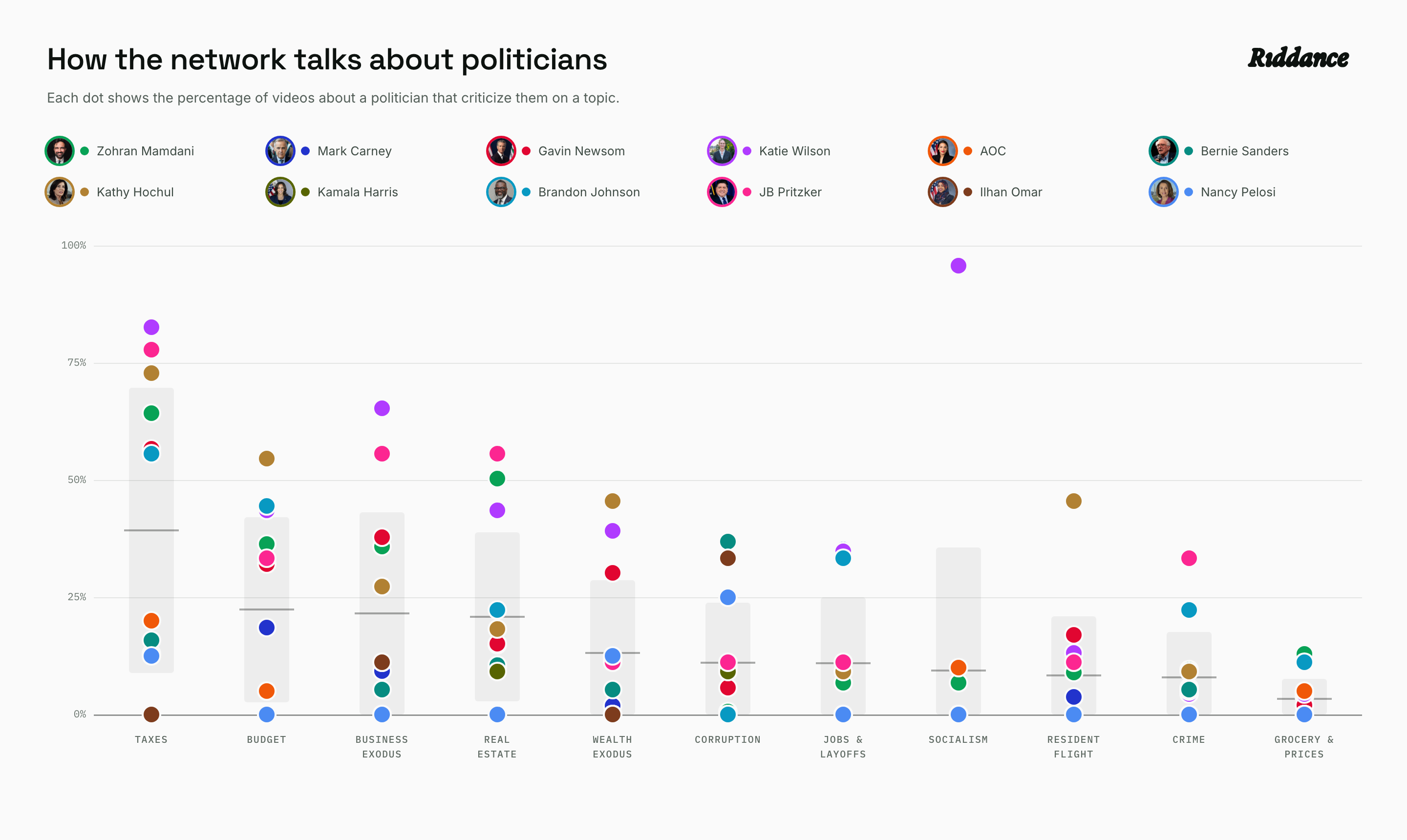
The most frequent attack combination was tax burden, business exodus, and real-estate crisis. The narrative arc of high taxes causing business to leave and an ensuing real-estate crisis was applied to Seattle, Chicago, and New York. Many of the criticisms of Canadian PM Mark Carney followed a similar pattern. Given the focus on sub-national politicians in the US and a single national figure in Canada, it’s likely the operator of this network is much better-versed in the US political landscape.
The first channel that caught our eye in the network was Julian News Report, and that is exemplified in charts. The channel stuck out because it targeted Seattle’s Katie Wilson almost as frequently as New York’s Zohran Mamdani, despite Wilson being far less prominent on the national stage. Note how nearly 100% of their videos about Wilson in the chart above mention socialism, with high taxes and business exodus also frequent attack targets. On the other hand, attacks on Mamdani are more evenly spread out, which could be a function of the sheer number of videos targeting the New York mayor.
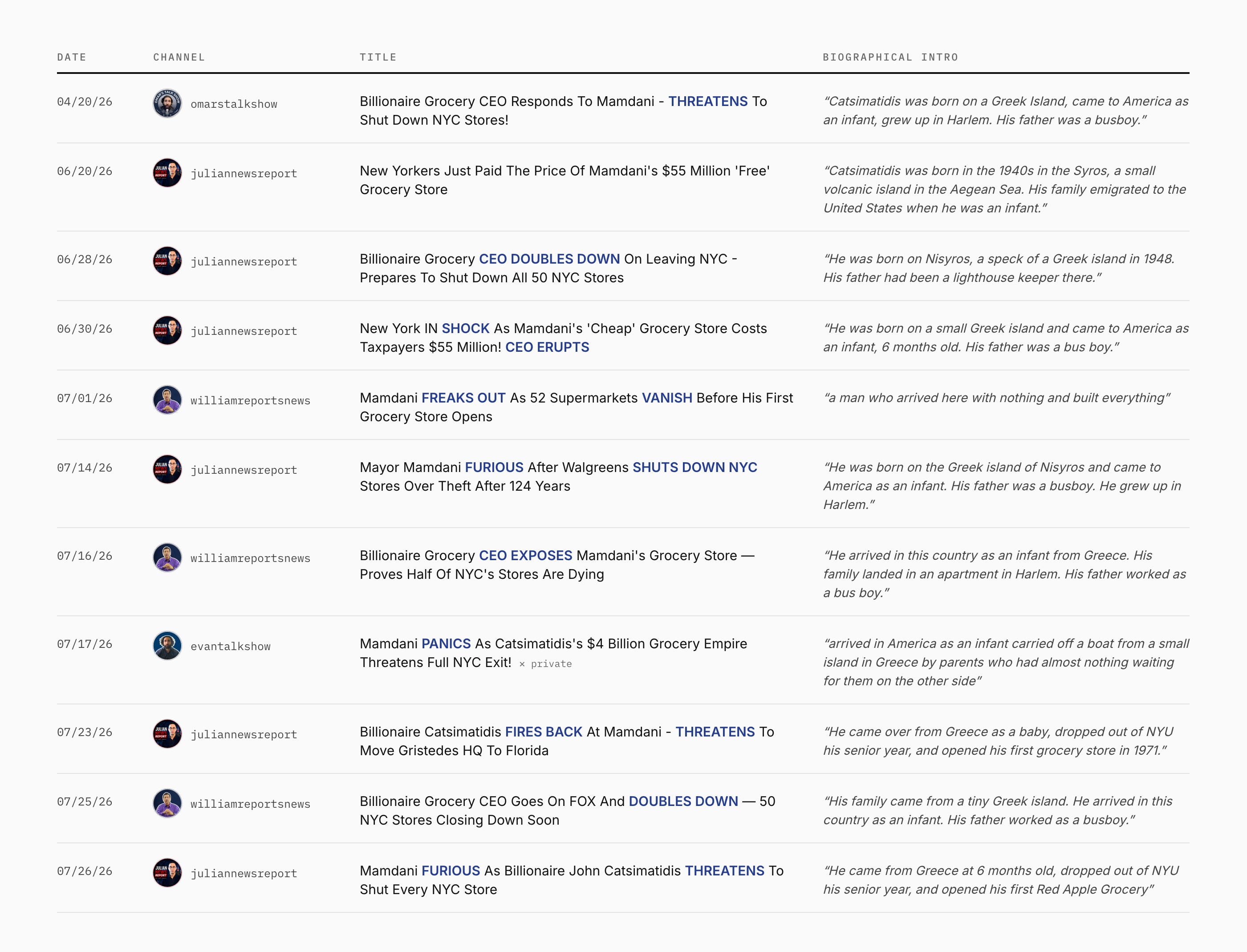
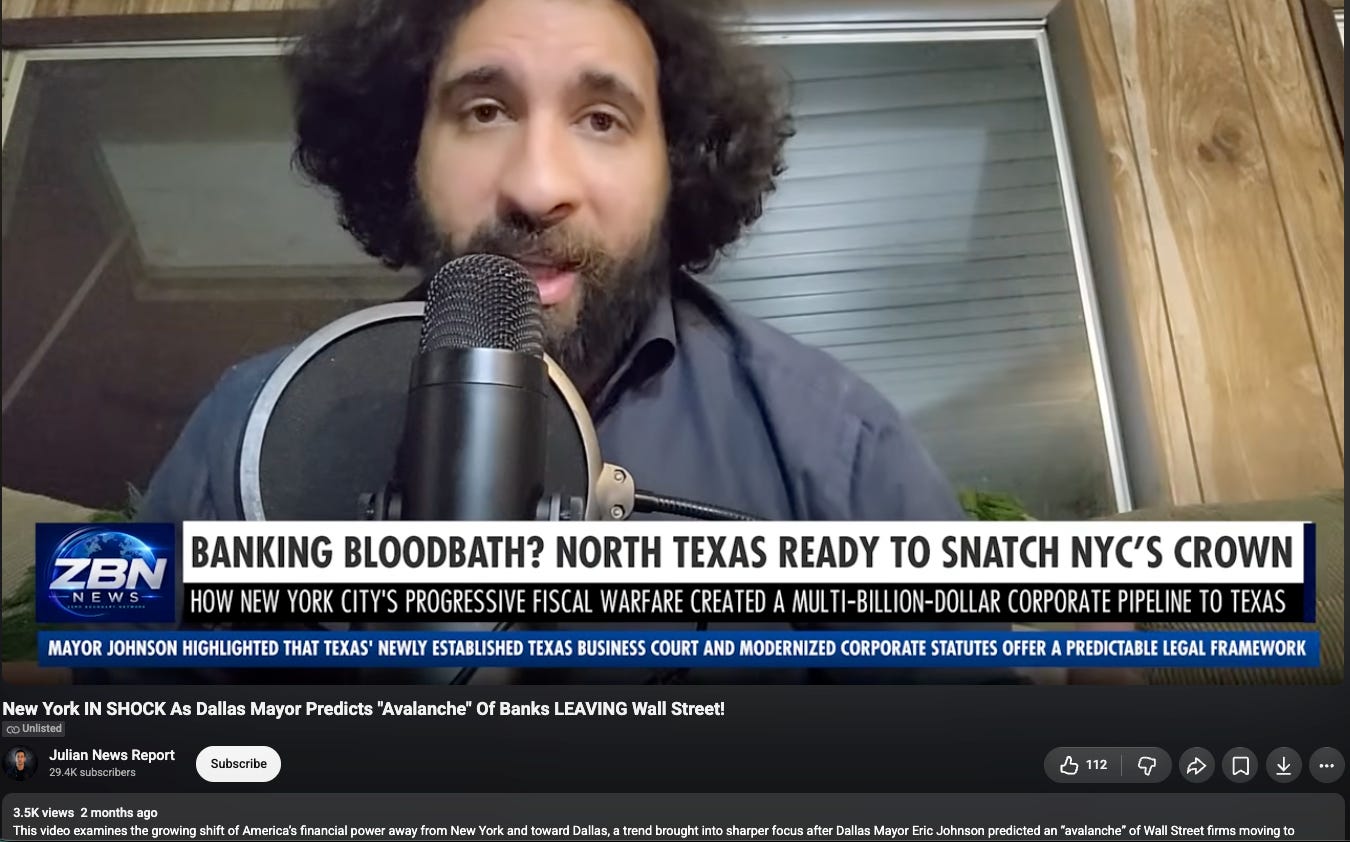
Many of their videos have an odd penchant for opening with cumbersome biographical details. In one instance, four personas used the same biographical details about billionaire grocery store owner John Catsimatidis, namely the fact that he was born on a Greek island, when pitting him against Mamdani’s plan for city-run grocery stores.
Despite never sharing entire scripts, the personas read many of the same segments verbatim. Several channels recycled hundreds of segments, and the longest shared segment was over 140 words long. To demonstrate, we ran a pairwise comparison of each persona’s entire transcript corpus against every other persona. This shows which accounts share copy most often. These shared runs exclude quotations, which would have made the overlaps higher still.
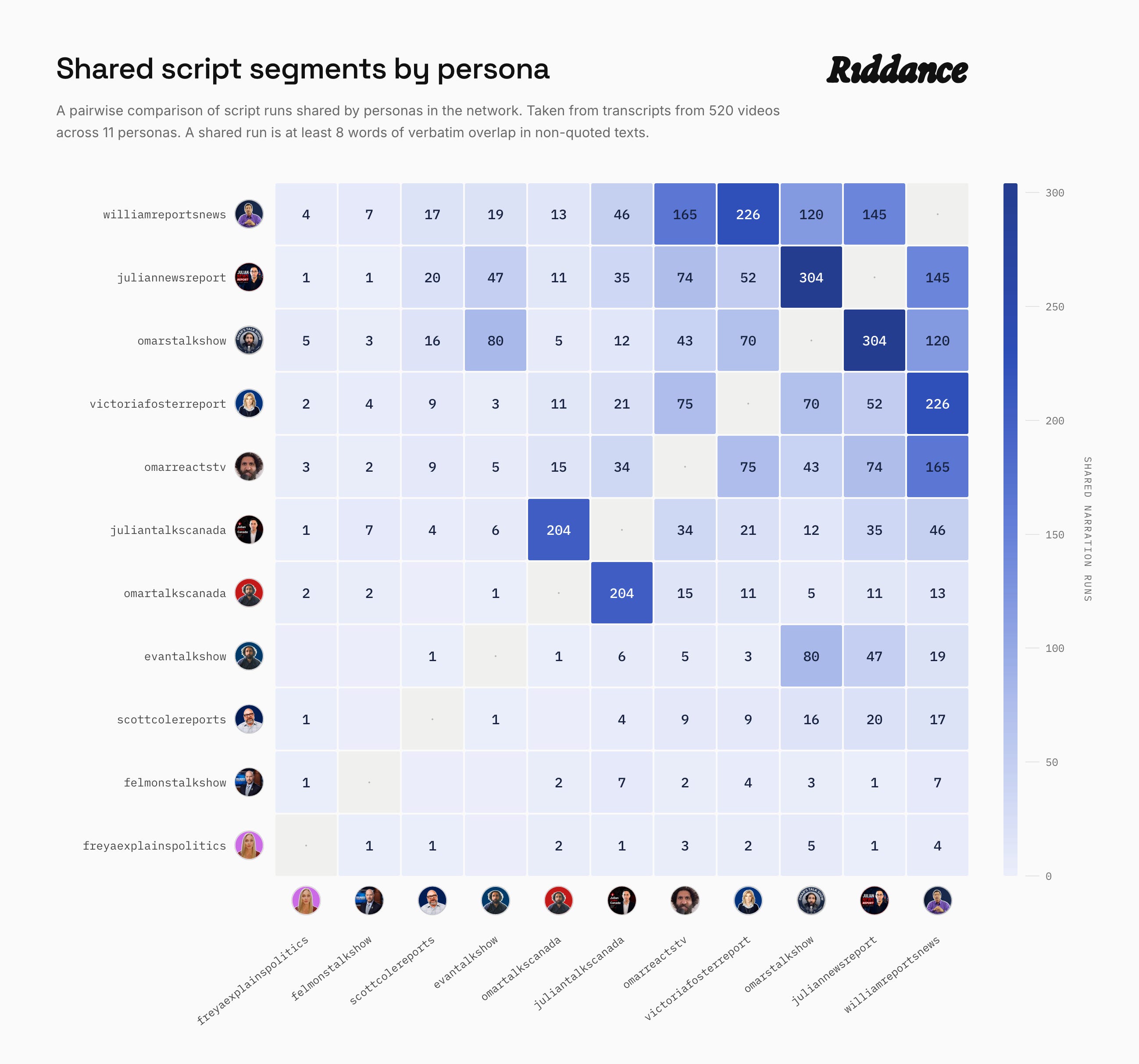
The similarities between the Omar and Julian personas jump out of the chart; their USA-focused channels (“OmarTalkShow” and “JulianNewsReport) and Canada-focused channels (“OmarTalksCanada” and “JulianTalksCanada”) share 304 and 204 script segments, respectively.
Shared infrastructure proved coordination
Forensic analysis of the websites associated with the hybrid personas, as well as systemic cross-posting on one another’s accounts and inconsistent visual artifacts, allowed us to make a high-confidence assessment that these accounts were likely run by the same actor.
The personas also likely share the same team of editors and editing workflows. Their videos have a distinctive editing style and cadence, as well as some shared assets. For example, every persona we tracked uses a song we call the “B-Minor Piano Song”, a very ominous music bed in the key of b-minor, that we’ve never heard outside of this network.
Another obvious tie between accounts is that the personas consistently appear on each others’ channels with no explanation. For example, in a now-unlisted video, the actor playing Omar from the “OmarsTalkShow” channel appears on one of Julian’s channels. This sort of mixup is extremely common for the network, but it’s not clear why. It’s unclear if these uploads are accidents, poor planning, or just strange decisions.
Many of the personas’ dedicated Linktree profiles and websites accidentally linked to a mismatched persona in the network. For example, Julian News Report’s website has a newsletter button that links to William Reports News (archived here).
Their websites use similar “vibe-coding” workflows and AI-generated coding tools. One group has a preference for color-highlighted, content groups of threes, and strange text formatting, all of which are common evidence of vibe-coded websites in general.
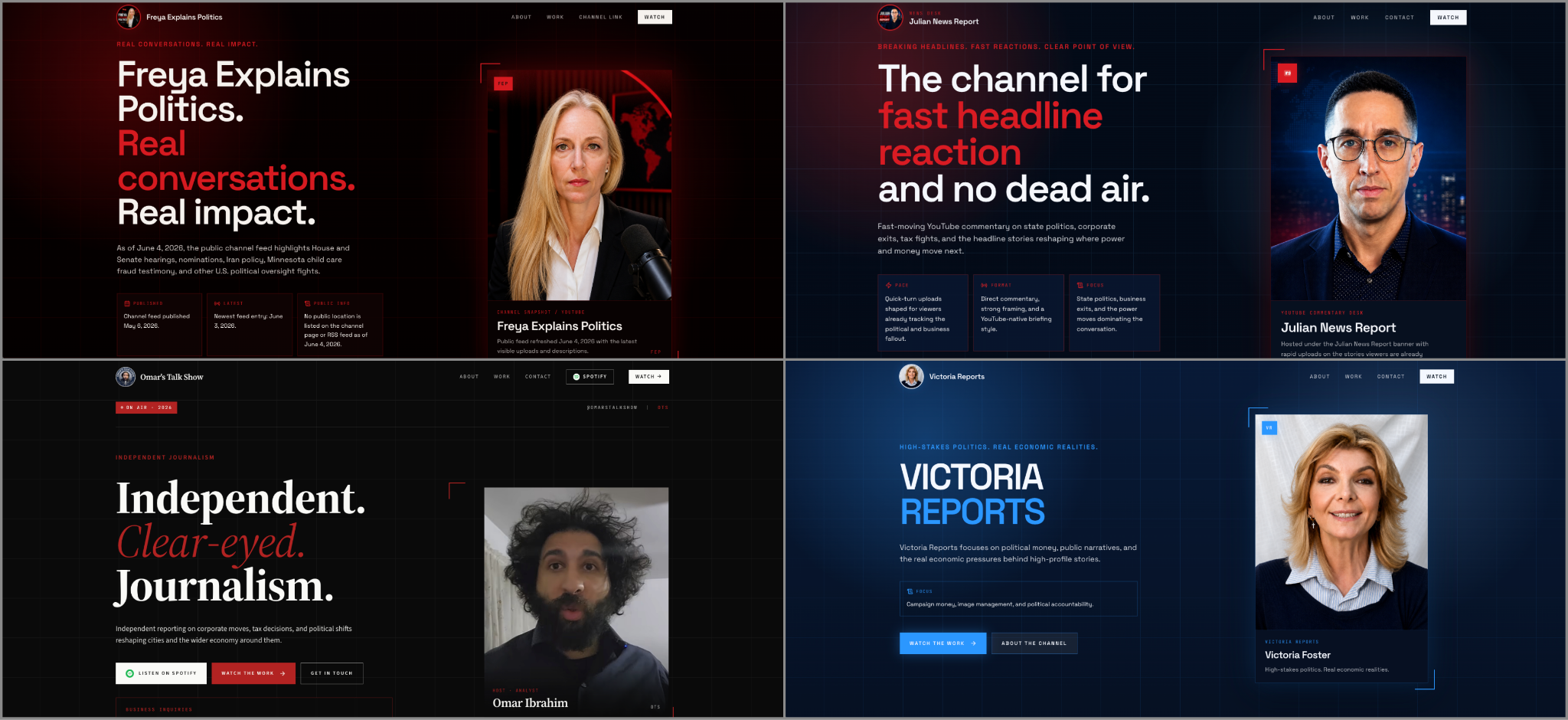
Furthermore, the websites are administered by the same site administrator. While they do not all share the same hosting or DNS information, they all were taken offline simultaneously on the afternoon of August 25th. Notably, this was after Semafor reached out to Virelox about the network. We archived different versions of the sites multiple times before they went down.
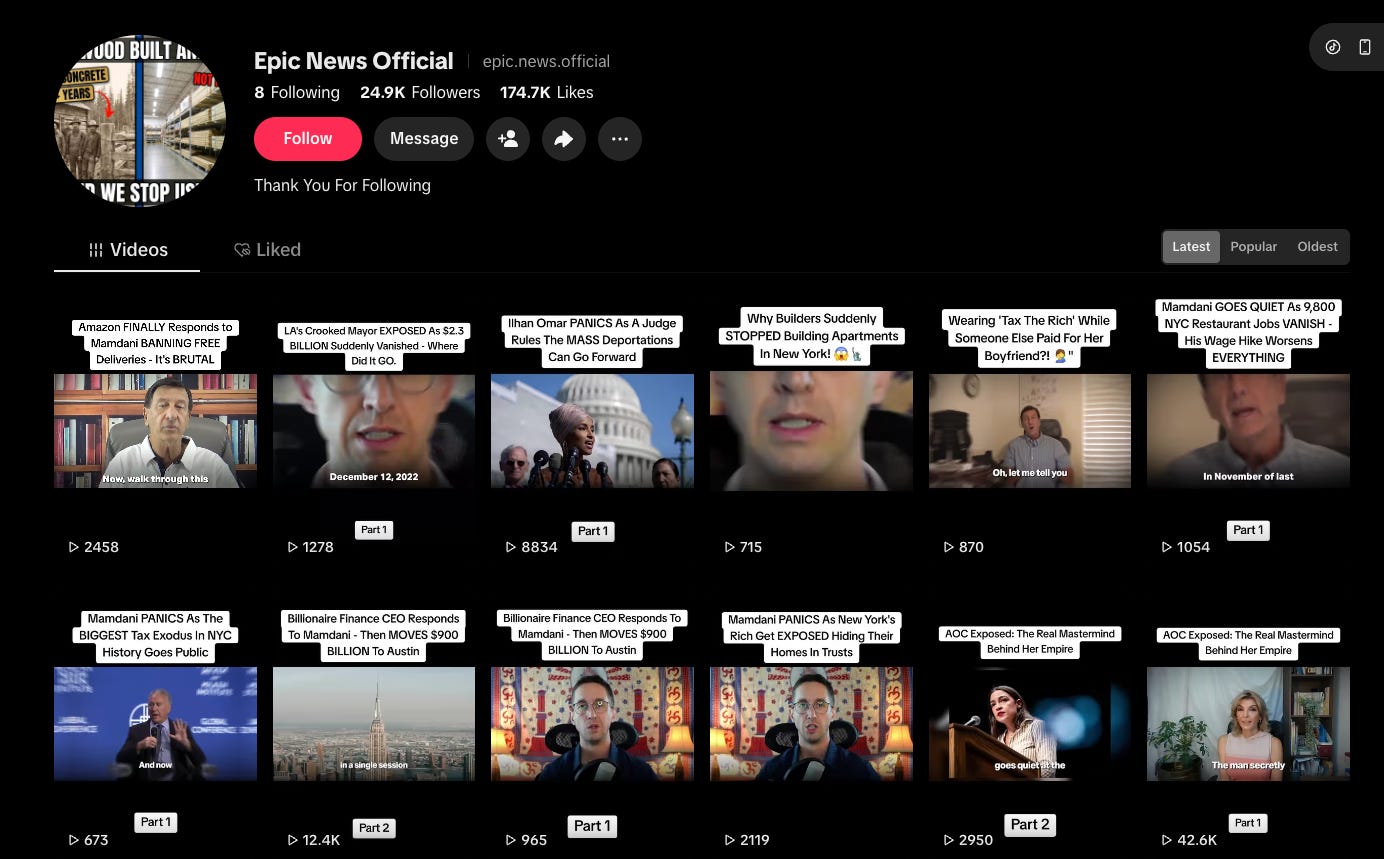
While most of this network’s activity is on YouTube, they also share a sizable clipping distribution network on TikTok. Clipping accounts take viral moments from other channels and circulate them for views. Riddance observed two types of clipping accounts circulating content from these hybrid AI personas. Some lump these personas in with broader AI-enabled anti-Democratic activity, while others seem to exclusively circulate clips from the hybrid AI personas.
Uncovering a shady operator with a huge reach
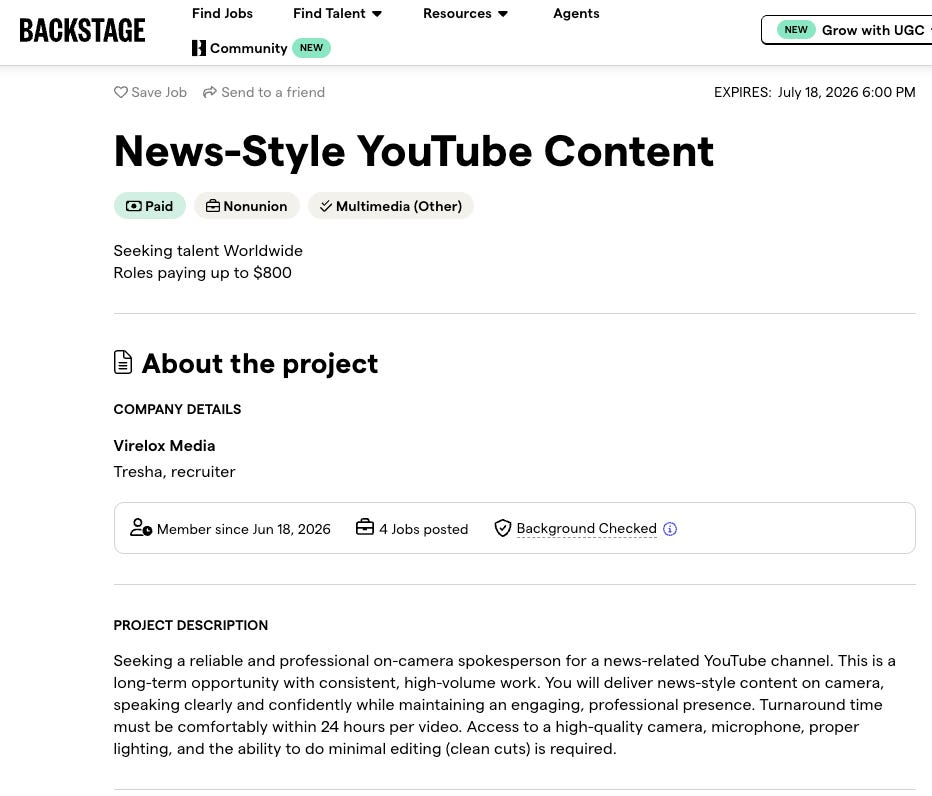
The network finds actors by using “paid spokesperson” services offered on gigging websites like Fiverr and Backstage. At the beginning of our investigation, we found the paid spokesperson who played the “Evan” persona. We thought it was possible that he didn’t know his likeness was being used and manipulated, so we reached out to ask how he was involved. He did not respond, but the videos and websites that used his likeness were wiped within a couple of weeks. Months later, the EvansTalkShow persona was replaced by the same actor that plays the Omar persona on other channels.
We found two other paid spokespeople on Fiverr as we started working with Semafor’s Maxwell Tani to uncover more about the network. Max learned that the actors were hired by a company called Casgains, which is connected to Virelox via its founder.
We then found several job listings on UpWork and Backstage from Virelox and Casgains soliciting a “professional on-camera spokesperson for a news-related YouTube channel” with Virelox offering to pay $26 per script they provided.
Virelox and its partners turn these actors into hybrid personas, or ghost creators. They maintain a unified identity across different platforms and mediums. They are active on YouTube, Medium, Spotify, and have personal websites with “investigative reports” containing citations and graphics. The quality of the writing is consistent with other AI generated content in this space, but the messaging is very focused. Furthermore, the multi-modal delivery–text and image-based articles, Spotify podcasts, and YouTube videos–coheres into convincing personas that seem to have captured a real audience. The vast majority of the network’s 90,000+ YouTube commenters are indistinguishable from, and substantially overlap with, commenters we see on other US domestic right-leaning YouTube channels.
“If an ideologically agnostic YouTube automation hustler decides that the best way to make money on YouTube is by pushing inflammatory content about a single political party, that points to something structurally wrong with YouTube’s engagement algorithm.”
We don’t know for sure whether these channels were created to harvest views and engagement revenue from YouTube, or if they were contracted by a 3rd party, but both possibilities present a real cause for concern. If an ideologically agnostic YouTube automation hustler decides that the best way to make money on YouTube is by pushing inflammatory content about a single political party, that points to something structurally wrong with YouTube’s engagement algorithm. If a third party were paying for this content, it would suggest someone with a political agenda is innovating on inauthentic content workflows ahead of the midterms.
The founder of Virelox told Semafor that “Virelox is an independent digital media publisher…[w]e do not produce content on behalf of political campaigns, PACs, ideological organizations, or paid clients, nor do we accept paid political sponsorships.” However, the Virelox website encouraged potential clients to “[g]et in touch and…discuss how Virelox can produce content for your brand.” And on X, the Virelox founder posted about getting paid to use ghost creators to help launch Cluely, an AI platform that helps people cheat on interviews.
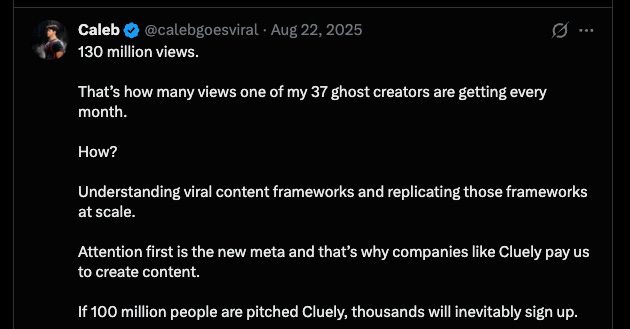
After outreach from Semafor, a video posted by the “Victoria Foster” and “Williams Reports News” channels added a disclaimer to an August 30th video:
“The perspectives, opinions, and analysis presented in this video reflect independent editorial commentary based on publicly available news reports, official statements, and verifiable third-party reporting… All commentary and presentations are performed by contracted, professional on-camera hosts and contributors.”
This disclaimer does not address the pseudonymous fake personas, the highly automated workflows behind the channels, or the real operator behind them.
Theoretically, AI-enabled workflows can automate every step in the content process. AI could write the scripts, generate b-roll images, generate thumbnails, code visual diagrams, and even edit and upload videos. But the weakest link is often the AI-generated videos themselves. Compelling direct-to-camera delivery is still difficult for AI video generation models. This creates a market opportunity that justifies hiring actors instead of generating sub-par AI avatars. The resulting content production cadence operates at the scale of AI slop, but gets engagement that mirrors authentic creators.
For companies like Virelox, a hybrid workflow is a selling point. Using paid actors helps them create more convincing personas. On the other hand, ghost creators are less clearly inauthentic, sitting in an ethical and policy gray area. Virelox’s CEO complained on Twitter last year that his AI-generated channels were getting removed by YouTube as they cracked down on automated content. The ghost creator pages have endured so far.
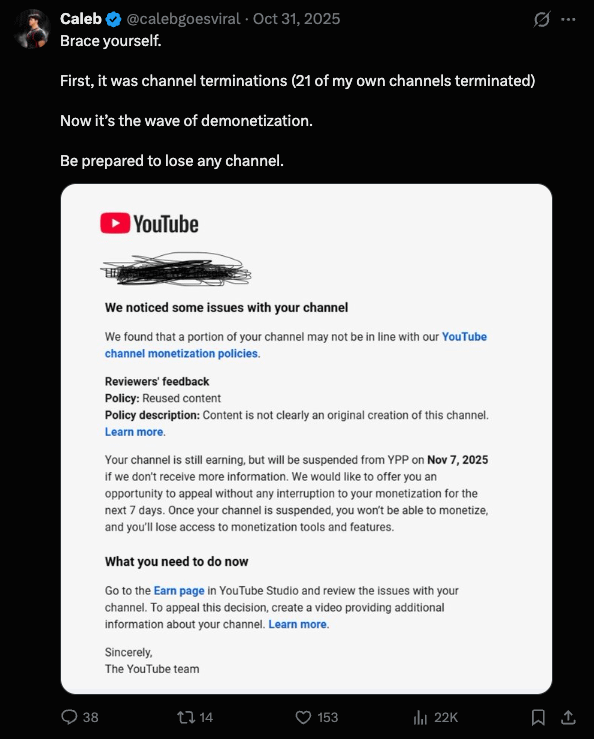
Virelox is only one company in the rapidly-expanding video automation space. As we looked at tweets and content shared by their associates, we researched the automation workflows involved. The workflows are easy to find and replicate, as YouTube automation tutorials are readily available both on X and YouTube itself.
We’re witnessing the beginning of the industrialization of YouTube automation. While operator skill and financial resources play a significant role, it’s clear that business ventures and political actors are taking advantage of cheaper mutli-modal AI models, open-sourced agentic pipelines, and gig-workers to engage and manipulate viewers.