


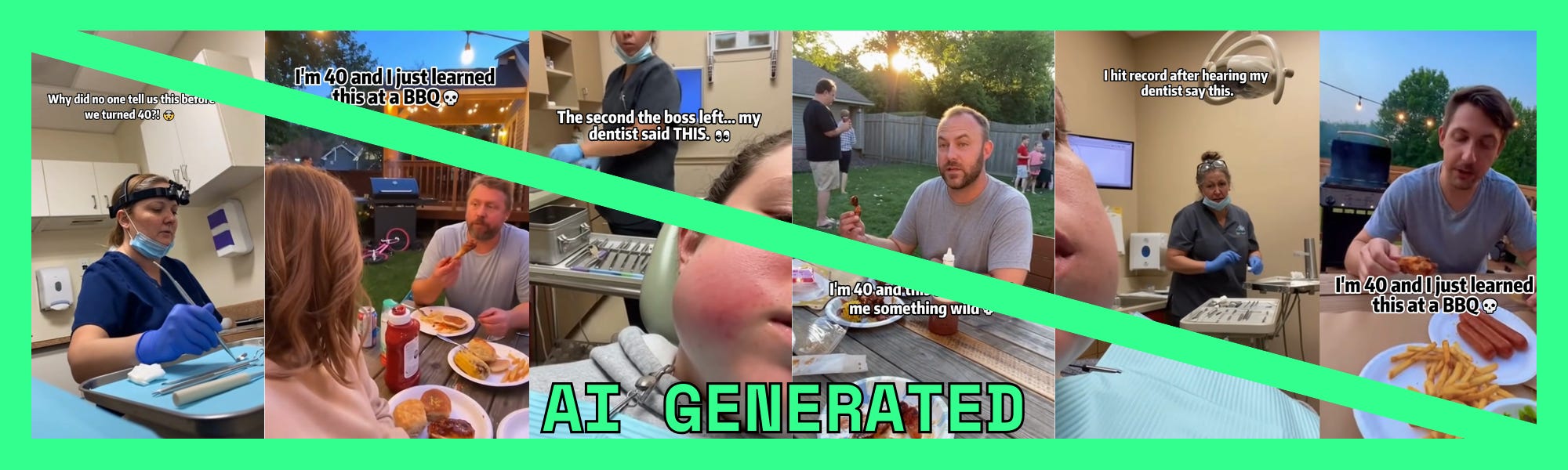
I was scrolling through a feed of AI-generated videos of men at backyard barbecues when I was hit by how absurd this script is:
“If your gums bleed while you floss, it’s probably plaque irritating your gums. Go grab KUGIG toothpaste. Not sponsored; just putting you on.”
— An AI-generated man, while eating chicken wings
The AI-generated man in this video had been prompted by an AI-generated woman to “say that again,” as if his insight into gum health was otherworldly. Something really irked me: why, in the spur of the moment, would a man ever say, “Not sponsored; just putting you on”? He’s supposed to be a regular guy, not an influencer reading from a script.
This weird nuance was multiplied hundreds of times across a mind-numbing number of videos. It’s just one of many weird, often funny mistakes I found in a collection of 720 AI-generated videos, which were posted by 136 accounts that create spammy, undisclosed advertisements for healthcare products like toothpaste, blood pressure supplements, or hair growth treatments.
Despite the absurdity, there’s something dangerous and irresponsible about an AI-generated persona hawking a product that a human might put into their body. None of these products are FDA approved, and some of them may cause harm, especially when they’re advertised to replace real, life-saving medication. While medical advertisements on social media are largely unregulated, there is often a manual or automated review process that screens ads for dangerous or harmful content. Unlabeled advertisements get around these meager safeguards.
In April, I covered a group of 57 TikTok accounts that were posting AI-generated advertisements for a toothpaste and feminine care brand called KUGIG. These videos were disgusting. Many depicted people suffering in dentist chairs with gnarly mouth infections.
I wanted to see what KUGIG was up to today, and I can confidently report that their videos have evolved, mutated, and multiplied. I found more unethical brands that have adopted similar posting strategies. The investigation yielded a weirdly homogeneous network of spammy accounts with videos that coordinate in very bizarre ways.
Besides at least 100 “backyard barbecue toothpaste ad” videos, there were other common formats:
A patient films a selfie video in a hospital. They open up the video saying, “Wait, repeat that one more time.” A nurse responds, “I’m only saying this once. High blood pressure means your blood vessels are under stress… use XAQNAD for blood pressure support. You didn’t hear it from me.”
This format is very flexible. It’s easy to swap in a dermatologist talking about a hair loss supplement (it would put her out of business!), or a dentist talking about a toothpaste (it would cut her work in half!). Here’s how KUGIG used the format:
An AI video “format” emerges from its repeatable, modifiable text-to-video prompt. Think of a prompt as mad-lib style text passage. Swap in “nurse” for “dentist”, or “blood pressure medication” for “toothpaste”, and the video will come out very differently. These prompts can be modified by humans, or large language model AI systems, to achieve a variety of videos with very little effort.
AI video generators create somewhat randomized videos. So, the exact same text prompt will yield a different video each time. These accounts use this to their advantage. If 100 different accounts posted the exact same video to TikTok, they would be severely penalized by the algorithm. But, if they post 100 very similar videos to TikTok, the algorithm is none the wiser.
But I’m not an algorithm; I’m an independent researcher working at a company that uses OSINT techniques to find AI videos. There was no shortage of indicators to quickly find these inauthentic, spammy accounts, which all clearly violate TikTok’s terms of service.
My favorite group of videos came from accounts that posted “backyard barbecue” formats with an oddly specific collection of captions and hashtags. Every video has a caption that reads “I’m 40 and just learned this at a BBQ”. The first hashtag that follows is “#40andlearning”. The problem becomes clear when you look at the hashtag column below:
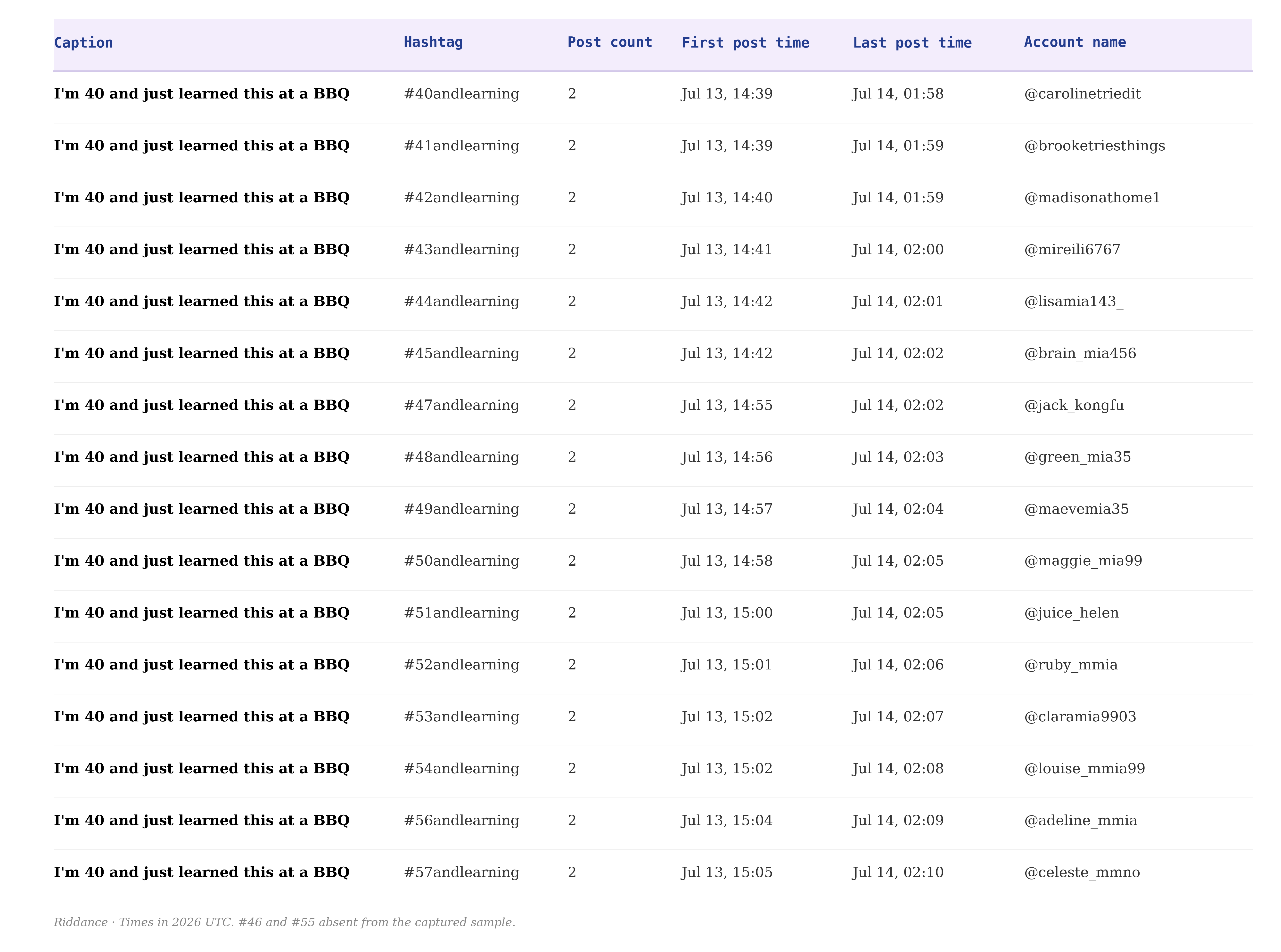
The hashtag’s age ascends with a 1-to-1 relation to an account. I don’t think this group was experimenting with different ages, because they would have changed the caption, too. Instead, I think we’re seeing the remnants of a click-and-drag mistake on a spreadsheet, which automatically ascended the numbers.
These accounts posted their videos sequentially, in order of their ascending hashtags, within 26 minutes of each other in their first round of videos. In the second round they cut the posting time to just 12 minutes in total—less than a minute per video. This is all evidence that these videos are uploaded by a script or automation system, rather than a human. Also, half of the account names have the name “Mia” in them, with similar character lengths.
Next, I found 23 videos that were supposed to advertise XKQ Hair Growth supplements. The problem was that they accidentally used the advertising copy for toothpaste, including the hashtags #dentalfacts #yellowteeth #cavities #hydroxyapatite #enamelrepair #hygienetips. Whoops! And, since the posting was automated and repeated, they fired videos off, one after another, without noticing. There were are more than 23 of these videos out there; I just decided to stop scrolling.
I also found another 22 videos with this exact caption:
1.I’m 40 and just learned this at a BBQ.Why did no one tell me sooner?
This short, clumsy passage is rich with information. The “1.” at the beginning probably shows that someone (or something) copied this exact caption from the first item in a list, forgetting to omit the number. The lack of spaces after periods may indicate that an automated system combined multiple cells from a spreadsheet into one string without adding spaces.
I’m just scratching the surface. This network is riddled with mistakes, as it rumbles across TikTok, leaving behind elephant-sized footprints. As we track the accounts over time, we see groups of accounts switching their formats at the same time, pivoting in a clumsy unison, sometimes deleting their old videos, though often forgetting to cover their tracks.
It may surprise you that accounts can be this coordinated and this sloppy at the same time, but that’s very normal. It’s not unique to accounts that are run by non-native English speakers, or spammy advertising campaigns, either. Sloppy coordinated posts will often betray domestic political influence operations, too.
It’s fun to find this clumsiness as you comb through data that represents something quite serious. It’s one of the best parts of doing this research, which is often tedious and daunting. What emerges is not a dead internet, but a quirky parallel internet full of weird, yet manipulative AI slop. It’s run by hasty humans, whose automated processes multiply their mistakes over and over, leaving a fascinating trail of clues for those who care to look.