


A sitting head of state had to post a proof-of-life video this week, responding to online rumors that he was dead and his government was using AI to cover it up. Call me crazy, but I think that’s a really big deal.
This happened because a video address by Israeli Prime Minister Benjamin Netanyahu was opportunistically screenshotted where it looked like his palm was a sixth finger. This wasn’t an AI generation artifact. In fact, I talked about how AI videos mostly fixed hands in my first-ever TikTok video almost a year ago. The AI accusations didn’t come from credible sources, but that didn’t stop the general public from getting really confused.
Pixel-peeping skeptics and attention-seeking creators are finding false-positive “AI artifacts” in every video that Netanyahu has posted since then. Many of the publications that arrived at this conclusion have been accused of being paid off by Israel or AIPAC.
Some commentators are dismissing this as an antisemitic conspiracy. But we can’t dismiss that the public deals with AI videos every day. Their confusion in this case is a natural reaction to their information environment.
This should be a major wake-up call for leaders in tech and government. I see this distrust every day in my inbox. It’s spilling out into the real world, and it’s getting worse.
Figuring out what’s real
Why am I so sure that Netanyahu’s address is real?
It’s a very long, single-camera take (eight minutes and twelve seconds long). That would be an insanely, nearly impossibly long AI video. Even an AI video that’s 20 seconds long struggles with temporal consistency. And without any visible edits or other AI artifacts, it would have to come from a theoretically very advanced AI model — one that doesn’t exist in public yet, and one that certainly wouldn’t add a sixth finger if it existed privately.
On the other hand, while a deepfake model could feasibly handle that duration, it couldn’t do the rest. Netanyahu’s hand hits the mic at 0:17 seconds with a sound to match it. There are noticeable smudges on the teleprompter screen that sits in front of the lens. The smudges around the face area wouldn’t have survived a face swap. Additionally, this just doesn’t look like a deepfake — his movements match too well with his speaking cadence.
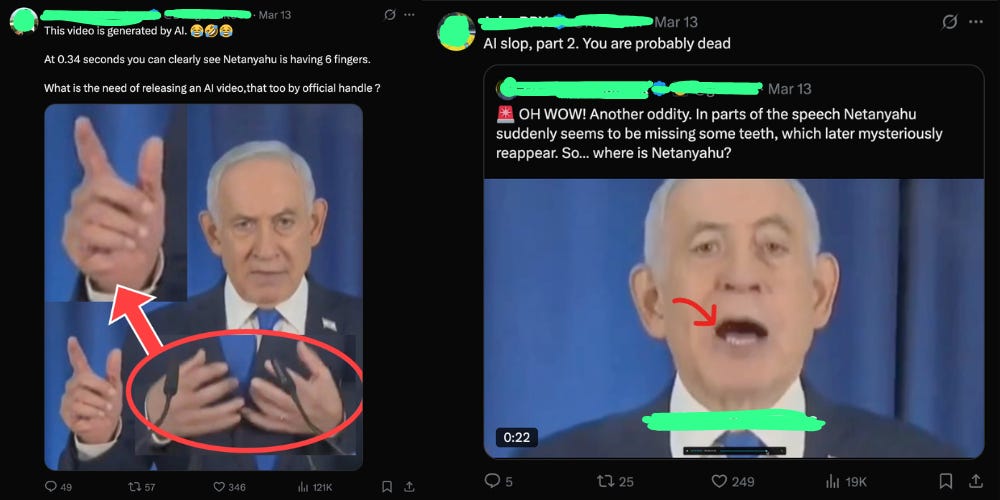
In the proof-of-life video and others following it, a lot of “AI proof” is just people looking too closely at weird things in real videos. I know this sounds like gaslighting coming from the “AI spotting guy”, but I’ll address that soon.
Under normal circumstances, these videos would not have been questioned. But between the sensationalist AI war videos, many real videos that show Israel fighting off counterattacks, and warnings about how many AI videos are out there, it’s reasonable to be confused and suspicious.
It won’t get any easier, either. Seedance 2.0 has freaked out the film industry, and looks like the most realistic AI video model yet. It’s already available in China, and was supposed to release on February 24th outside of China. It was delayed, probably for technical or legal reasons, but I like to imagine that they’re finally, responsibly slowing down.
We’re entering a world where experts are the only “dependable” voices in the AI vs real debate. But expert judgement doesn’t scale, and experts aren’t held in high regard. I think that teaching media literacy is more dependable, but even that is hitting its limit. So as a regular person, what are you supposed to do?
A new information environment
The Netanyahu AI story broke through to regular people. I received a lot of messages from personal friends who really thought that the Israeli government was using AI. These were all media-literate, smart people under the age of 35. This isn’t normal.
I still don’t blame anyone who thinks these videos are AI, because our trust systems are failing right now. Checking the source still works, and that’s still what I recommend. But in this case, so many accounts were posting about this theory that it was hard to ignore or dismiss. Looking closely for AI artifacts just yielded false positives.
This is a wake-up call for me, too. I’m part of the problem. I saw a lot of methods I talk about (look at the hands, teeth, odd blur artifacts, etc) misused or misinterpreted, sometimes intentionally. To be fair, I never want these artifacts alone to be “proof” of AI generation, but rather “red flags” to make people check the source. Weird things happen in real videos all the time, and even I have tricked myself into thinking real videos were AI.
The public doesn’t know who to trust. Some people are behind the curve and underrating AI videos, but many people are actually overrating them, over-generalizing their capabilities for self-preservation.
That’s why checking the source and determining if it’s trustworthy is the solution for now. Anyone can do it. But that’s a problem for the Netanyahu videos.
Trust
If you don’t trust Netanyahu in general, you probably won’t rule out that he, or his team, would use AI for videos. I think this makes sense. After all, he’s part of the cohort of world and tech leaders who are letting AI take over the internet and using AI to disastrous effect.
Despite the technological differences between AI video generators, large language models, and military-specific AI solutions from companies like Palantir, the public just knows these things as “AI.” The US-Israeli military alliance uses both civilian-accessible generative AI models and proprietary AI systems. The White House puts out altered media and AI slopaganda, so there’s a precedent.
Companies like xAI and OpenAI work directly with militaries, while also subsidizing AI photo and video generation. World leaders have leverage to make them stop, but they don’t. They aren’t putting their heads together to write laws for AI safety, or incentivizing social media companies to invest in trust and safety teams. Healthy democracies rely on an informed, trusting public. And yet, leaders push forward, often taking advantage of the distrust.
AI photos and videos don’t have to be that good to wreak havoc in this environment, but they’re clearly already good enough. The “future” that everyone was scared of, where regular people don’t know what’s real and only experts can help them figure it out, has arrived. Its arrival was quiet and unceremonious, until now.